
PCOS and Hair Thinning: How to Tell If It Is Actually the PCOS
PCOS and Hair Thinning
PCOS can cause hair thinning, and it is less common than the excess facial and body hair most people associate with the condition. Around 70% of women with PCOS have hirsutism, while scalp thinning shows up less often. That gap is why a widening part in a woman with PCOS still deserves a workup rather than an assumption.
By Dr. Joyce Park, MD, Board-Certified Dermatologist and Founder of Kerativ
What Does PCOS Hair Loss Look Like?
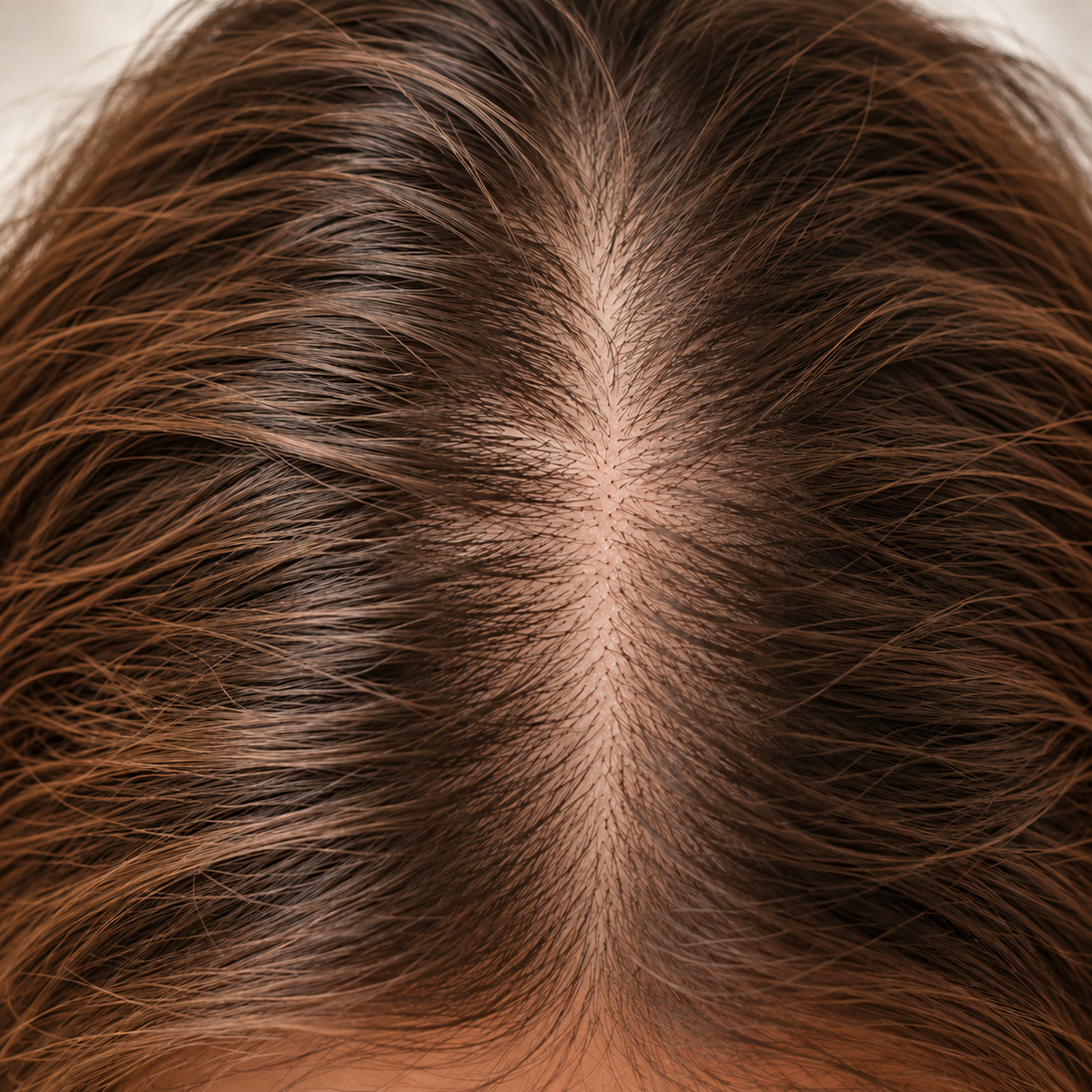
She was 29, and she had been diagnosed with PCOS at 22, which meant she had spent seven years assuming that every symptom she developed belonged to it. The one that finally brought her to me was her part. It had widened over about eighteen months, enough that she had moved where she parted her hair and then moved it again. She told me she had already accepted it and just wanted to know how fast it was going to go.
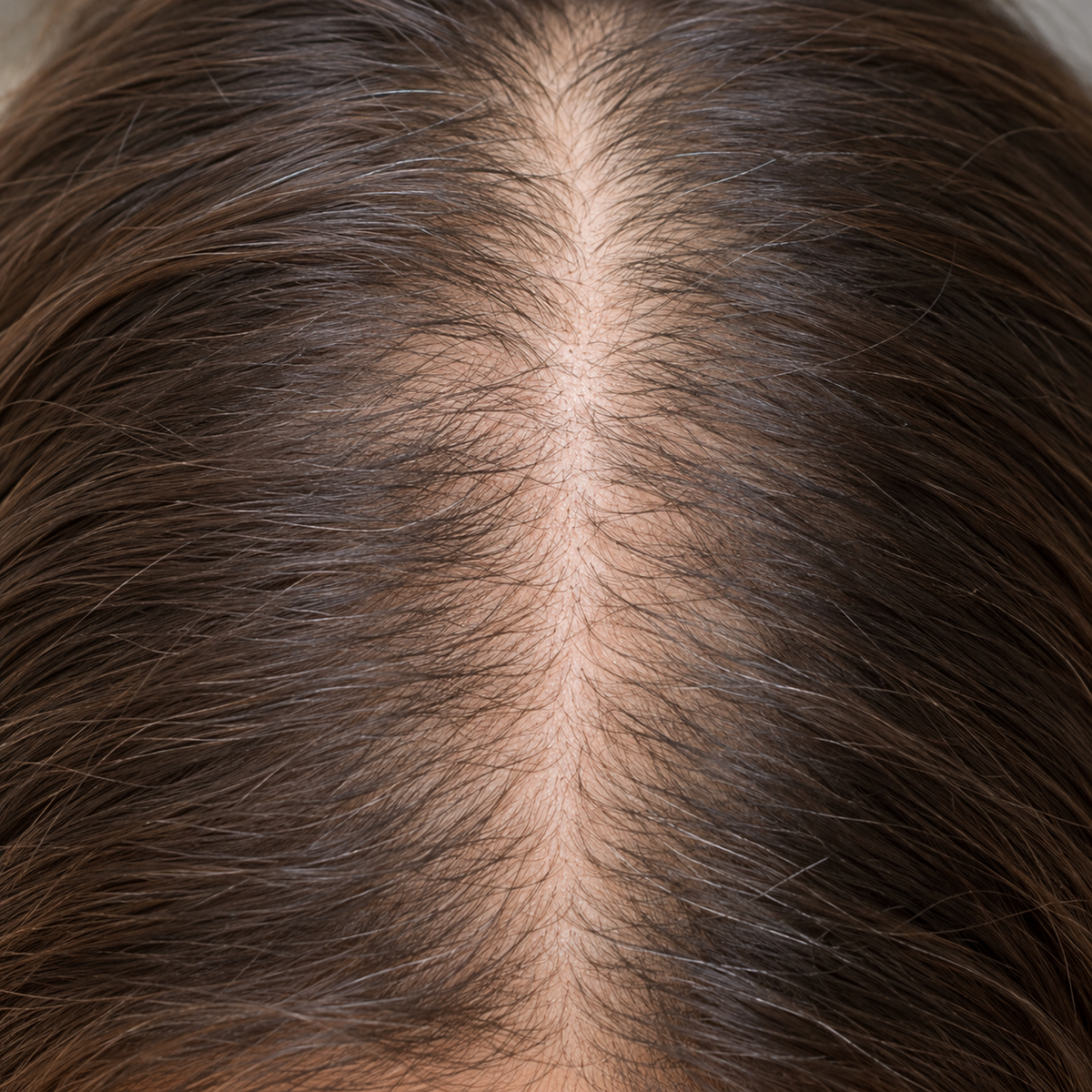
I told her we were not there yet. On dermoscopy the pattern was androgenetic: miniaturized hairs through the crown, a widening part, the frontal hairline intact. That part fit the PCOS. What did not fit was everything else, because her ferritin came back at 14 and she had started a new medication eight months earlier. PCOS was on her chart, and it was not the only thing on her scalp. For context, PCOS affects somewhere between 5% and 26% of reproductive-age women depending on which diagnostic criteria are applied, and around 70% of women with it experience hirsutism, meaning coarse hair growth in a male pattern on the face, chest or abdomen.
Why Does PCOS Cause Hair Thinning?
PCOS raises circulating androgens, and follicles on the top of the scalp that are genetically sensitive to androgens respond by miniaturizing. Each cycle produces a hair that is a little finer, a little shorter, a little less pigmented, until the follicle is making something closer to peach fuzz than to a full terminal hair. The follicle does not die. It shrinks.
That is the same mechanism as I described in my post the why behind female pattern thinning, so I will not repeat all of it here. What PCOS adds is an androgen source that is present from a much younger age, which is why women with PCOS can be seeing this in their twenties rather than their forties, and why it can look further along than their age would suggest.
It is also worth noting that the same androgens which thin hair on the scalp thicken it on the face and body. One signal, opposite effects in two different follicle populations, which is why hirsutism and scalp thinning tend to travel together.
Is It the PCOS, or Is It Something Else?
Not every woman with PCOS and thinning hair is thinning because of the PCOS.
Hirsutism is by far the most common androgenic skin sign in PCOS, at around 70%. Scalp thinning shows up considerably less often, and one major endocrinology reference goes as far as describing androgenic alopecia as relatively rare among women with the condition. When a woman with PCOS notices her part widening, she already has a diagnosis sitting there ready to explain it, and that is exactly the situation where a second and treatable cause gets missed.
So in clinic I still run the whole workup. Ferritin, thyroid function, a review of any new medications, and a careful history of the previous six months for anything that could have set off the diffuse shedding of telogen effluvium. Iron deficiency in particular is common in this group, because irregular and sometimes very heavy cycles are part of the condition itself.
Often the answer turns out to be that both things are true. The PCOS is driving a slow androgenetic pattern underneath, and something else is layered on top of it. The layered-on part is usually the one that comes back.
Signs Your Thinning Is Androgen-Driven
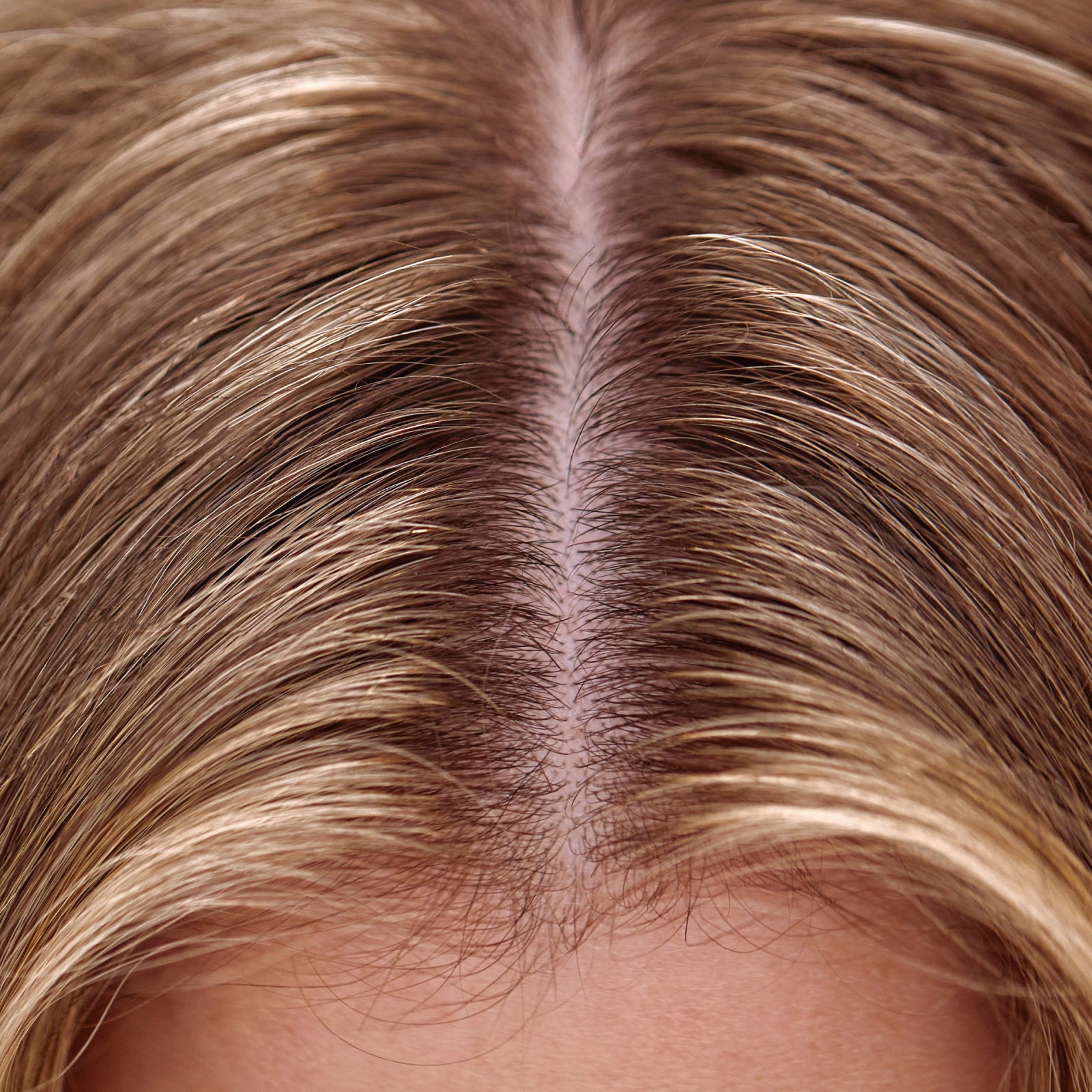
The pattern that points to androgens, next to the one that does not. Schematic, and no substitute for an examination.
- The part line widens progressively over months to years, rather than the whole scalp thinning at once over a few weeks.
- Density drops at the crown and mid-scalp while the frontal hairline stays exactly where it has always been.
- Individual strands in the thinning areas look finer and shorter than the hair at the back of your head.
- In more marked hyperandrogenism the temples can recede and the frontal hairline can begin to move back.
- The hair at the back and sides holds its density, because those follicles are not androgen-sensitive in the same way.
- Coarse hair appears in a male pattern on the chin, upper lip, chest or abdomen over the same period.
- Shedding volume in the shower may look completely normal, because this is miniaturization rather than a shedding event.
- The change is gradual enough that most women only see it clearly when they compare photographs two years apart.
What I Tell My Patients
The hair is one symptom of something systemic, and treating the hair without treating the cause is working on the wrong end of the problem. I have lost count of how many patients I have sent to a gynecologist to be evaluated for PCOS who came back months later telling me that getting the PCOS properly managed helped things they had never thought to connect to it. Let the medical piece sit with your physician, and let scalp care be the part that supports it.
 Dr. Joyce Park Dermatologist & Founder of Kerativ
What Helps PCOS-Related Hair Thinning
The medical options belong to your physician, and it is worth knowing what they are so that you can have the conversation rather than wait for someone to raise it. Combined oral contraceptives lower circulating androgens. Spironolactone is commonly used off-label as an androgen blocker for hair. Metformin and inositol address the insulin resistance side of PCOS. And topical minoxidil is the one FDA-approved topical for pattern hair loss in women, and it works on the pattern regardless of what is driving it. None of that is something I can start for you through a blogpost, and all of it is worth asking about.
Before anything else, one thing you need to know about the serum. The Redensify Treatment Serum is not for use during pregnancy or while breastfeeding, because it contains a retinoid and saw palmetto. PCOS is a leading cause of anovulatory infertility, so a good number of the women reading this are actively trying to conceive, in fertility treatment, or nursing. If that is you, start with the shampoo now and add the serum once you have finished breastfeeding.

The Serum
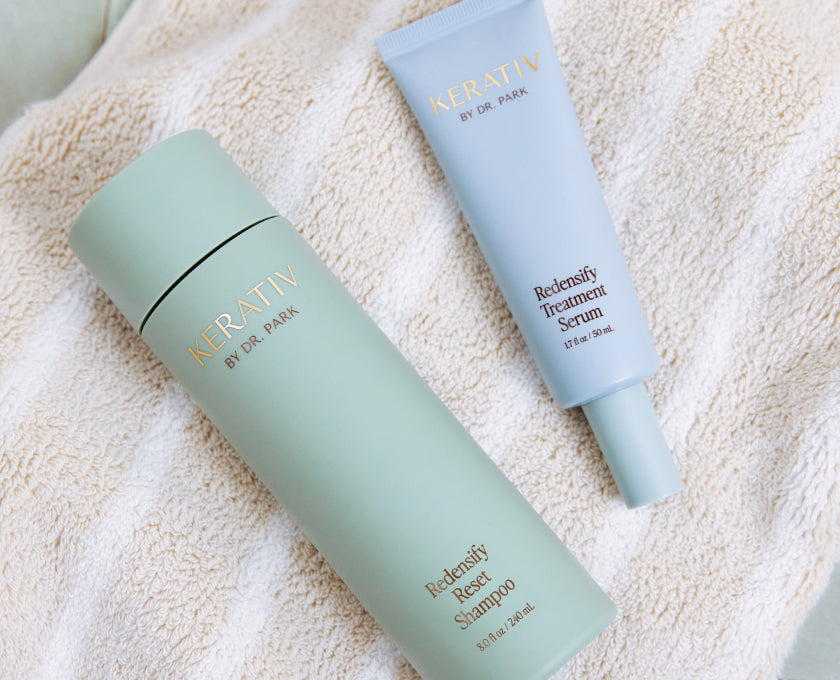
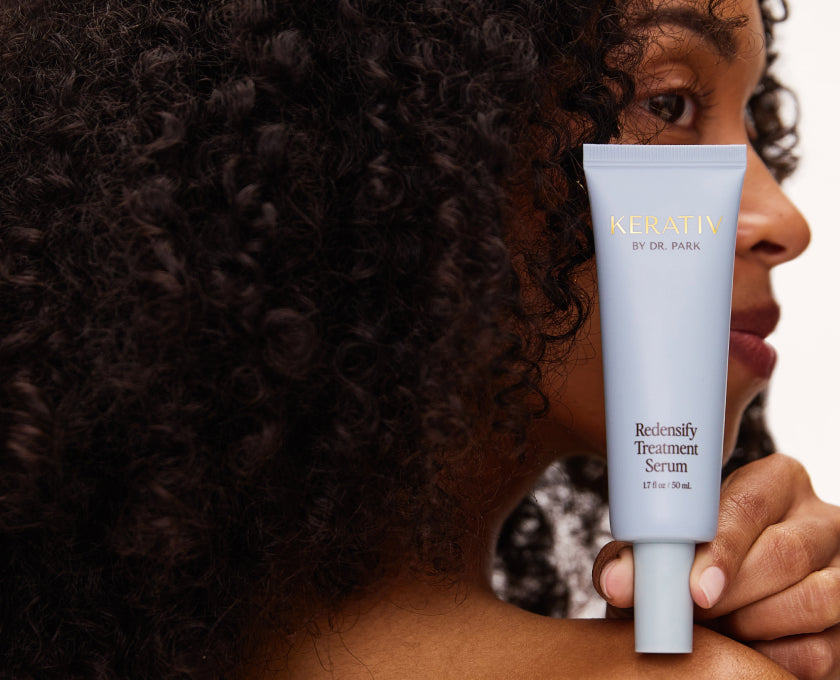
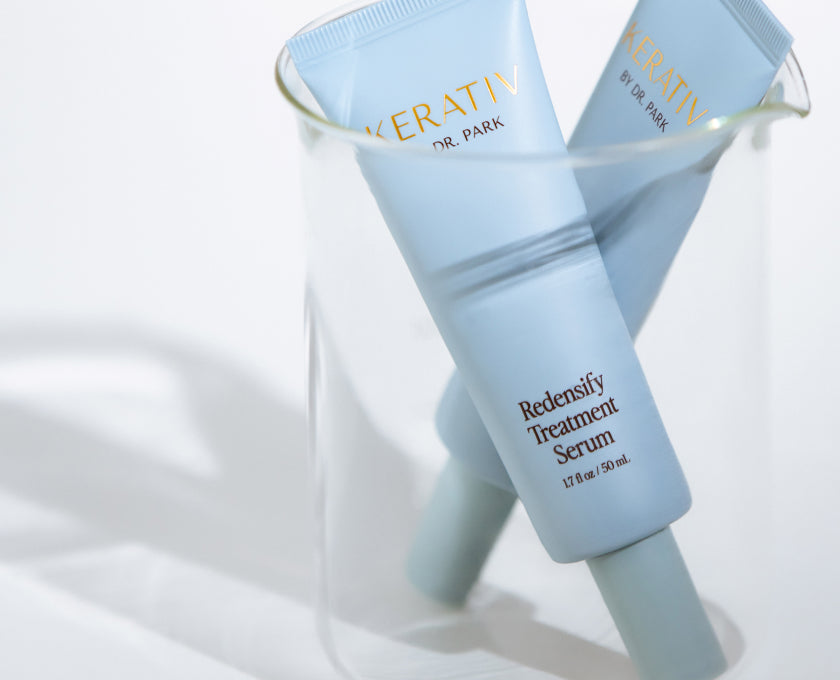
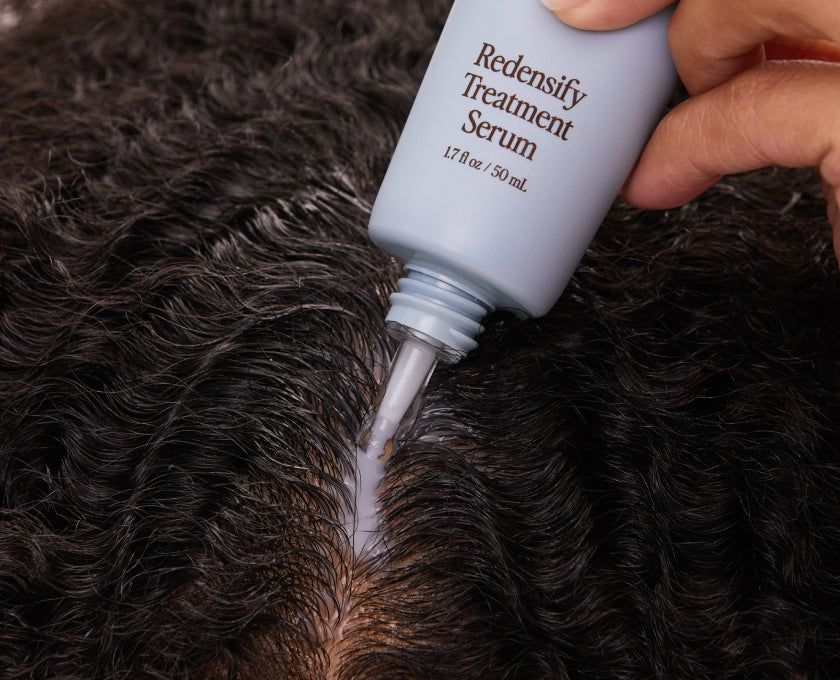
Redensify Treatment Serum
The serum is a dermatologist-developed, fragrance-free scalp serum that nourishes the scalp and follicles to support fuller, denser, healthier-looking hair. In an independent 24-week clinical study of the Kerativ Redensify Treatment Serum, hair density and volume improved at 3 months, and thickness at 6.*

The Shampoo
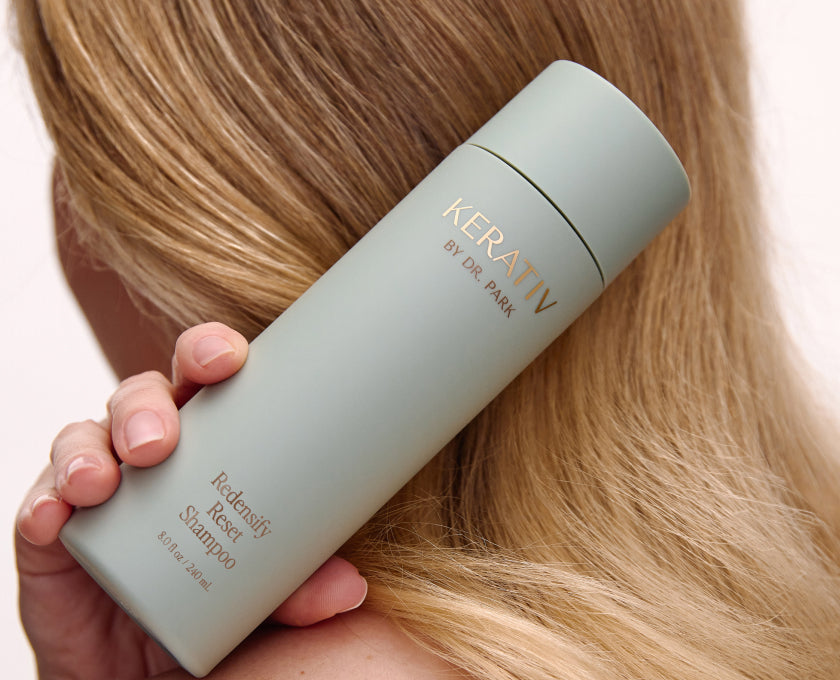
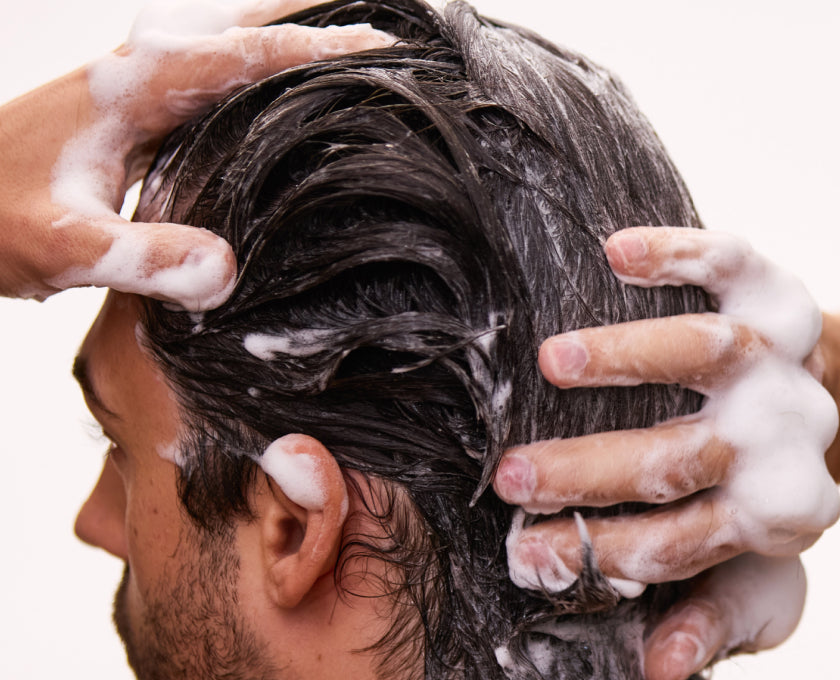
Redensify Reset Shampoo
The Redensify Reset Shampoo is a dermatologist-developed sulfate-free gel shampoo that gently cleanses the scalp and hair while adding lightweight volume to fine strands. It does not contain the retinoid or the saw palmetto, so it is the one to start with if you are pregnant, nursing, or trying.

The Regimen
Redensify Regimen
The Redensify Regimen is both together at a bundled price, for when the timing works.
Why Scalp-First Care Matters Here
It supports the scalp, but it does not address the hormones. This is the honest limit and I would rather say it plainly. Besides topical medications from your physician, nothing you put on your scalp can really change your systemic androgen levels. The hormonal side is managed with your physician, and a topical routine works alongside that rather than instead of it.
Starting early matters more here than almost anywhere. Androgen-driven thinning in PCOS often begins in a woman's twenties, which means there is usually a lot of active follicle left to support. The follicles that are still working today are the ones most responsive to anything you do.
Designed to sit alongside medical treatment, not replace it. The regimen is a cosmetic scalp routine and is formulated to complement whatever your dermatologist or physician has you on.
Cosmetic products are not drugs and are not intended to diagnose, treat, cure, or prevent any disease. PCOS is a medical condition that should be evaluated and managed by your physician, gynecologist or endocrinologist, alongside a board-certified dermatologist for the hair. The Redensify Treatment Serum is not recommended during pregnancy or while breastfeeding.
*Based on a 24-week clinical study with 32 participants, dermatologist-evaluated. Results may vary.
Frequently Asked Questions
Is PCOS hair loss reversible?
Androgen-driven thinning of the kind PCOS produces is a chronic process rather than a single episode, so the honest framing is that it can be slowed, held steady, and in some women meaningfully improved with treatment, rather than switched off. What I would push back on is the assumption that nothing can be done, because women who start early, get the PCOS itself properly managed, and stay consistent generally do considerably better than women who wait to see what happens. And if part of what is going on is an iron deficiency or a shedding episode sitting on top of the pattern, that part usually does come back fully once it has been corrected.
Does treating PCOS with medication stop the hair thinning?
It often helps and it rarely does the whole job on its own, because lowering androgens removes the driver but does not undo miniaturization that has already happened. A follicle needs both time and support before it produces a fuller hair again. I advise treating both ends at once, meaning the hormonal management with your physician and a topical approach for the scalp, and then giving it 6 to 12 months before you judge whether it is working, because hair moves slowly no matter what you throw at it.
Can you have PCOS hair loss with normal testosterone levels?
Yes, and this catches a lot of women out, because sensitivity to androgens is genetic, and a highly sensitive follicle will miniaturize at hormone levels that sit comfortably inside the reference range. As a dermatologist, I want to highlight this point: a normal testosterone result does not rule out androgen-driven thinning, and it does not mean the pattern your dermatologist is describing on dermoscopy is not there.
Is it safe to use a scalp serum while trying to conceive?
The Redensify Treatment Serum contains a retinoid and saw palmetto, and I do not recommend it during pregnancy or while breastfeeding. If you are actively trying to conceive, this is a conversation to have with your OB-GYN, and my own preference is that patients stop the serum once they start trying rather than waiting for a positive test. The Redensify Reset Shampoo does not contain those ingredients and is fine to keep using throughout, so starting there and adding the serum once you have finished breastfeeding is the sequence I would suggest.
How long before I see a difference from a scalp serum?
You will typically start seeing fuller-looking hair around the 3-month mark with consistent twice-daily use. In the first few weeks your scalp begins to rebalance, and some people notice a brief increase in shedding as follicles shift into a healthier cycle, which is normal and temporary. Around 3 months hair starts to look fuller and denser with less noticeable thinning, and thickness takes longer, which is why I recommend committing to at least 6 months. Because PCOS thinning is ongoing rather than an episode, this is a routine to keep rather than a course to finish.
What to Read Next
If your ferritin came back low, what your ferritin number actually means explains the level that matters for hair and how to ask for it. If your thinning arrived as a sudden wave of shedding rather than a slowly widening part, the diffuse shedding of telogen effluvium is the one to read. And for the full mechanism behind the pattern itself, the why behind female pattern thinning goes through it step by step.