


Scalp Massage for Hair Growth: What the Evidence Actually Shows
Scalp Massage
Does It Actually Work, and How Should You Do It?
Scalp massage has some evidence behind it, and the evidence is small. One 24-week study of nine men found a modest increase in hair thickness, and a survey of 340 people found most felt their shedding had settled. If you want to try, it doesn’t hurt, but know that it is definitely not a substitute for a treatment with clinical data.
By Dr. Joyce Park, MD, Board-Certified Dermatologist and Founder of Kerativ
Scalp massage is having a moment. It is on every hair forum, in every routine video, and patients bring it up in clinic most weeks now.
I like it, and I have been recommending it for years. But the evidence behind it is a lot smaller than the internet suggests, and it is worth knowing exactly how small before you decide how much to expect from it.
There are two studies. That is essentially the whole literature!
Does Scalp Massage Actually Help Hair Growth?
The whole published evidence base, side by side: Koyama et al, 2016 and English and Barazesh, 2019.
Probably a little, but the studies are small enough that "probably a little" is as far as they honestly take us.
The first is a 2016 Japanese study that put nine healthy men through 24 weeks of standardized scalp massage, 4 minutes a day, using a device. Hair thickness went from 0.085 mm at baseline to 0.092 mm at the end. That is a real measured change. It is also nine men, with no control group, using a machine rather than their hands.
The second is a 2019 survey of people with androgenetic alopecia who had been doing twice-daily 20-minute standardized massages on their own. Of the 340 who responded, the authors reported 68.9% "reporting hair loss stabilization or regrowth". They are careful about what that means, and so am I. There was no placebo or control group, everything was self-reported and assessed after the fact, and people who commit to 40 minutes of scalp massage a day are not a neutral sample of anyone.
So the honest summary is that a technique with a plausible mechanism has two studies pointing weakly in a good direction, and neither one is the kind of evidence that would get a drug approved.
What the Evidence Does and Does Not Support
| What you will hear | What the studies actually show | What they do not show |
|---|---|---|
| Scalp massage regrows hair | Nine men gained about 0.007 mm of strand thickness over 24 weeks, and 68.9% of survey respondents felt their loss had stabilized or improved | Neither study counted hairs or measured density, and neither had a control group |
| It works by increasing blood flow to the follicle | The 2016 authors proposed mechanical stretch on the cells at the base of the follicle, which is a different mechanism from circulation | No study has shown that changing scalp blood flow produces more hair in humans |
| It works as well as minoxidil | Nothing has ever compared the two directly | Minoxidil has decades of randomized controlled data behind it. Scalp massage has none. |
| More is better | Both studies used a fixed daily protocol, and the survey found that longer adherence tracked with better self-reported outcomes | No study has tested whether harder or longer is better, and aggressive massage can break hair |
What I Tell My Patients
Scalp massage is free, it feels good, it can help with circulation to the scalp, and for a lot of my patients it is a part of their self care routine. I recommend it as one part of a routine rather than as the thing that is going to change your density. Use light pressure with the pads of your fingers or a massage tool, and make sure not to be too aggressive with your scalp or hair in the process.
 Dr. Joyce Park Dermatologist & Founder of Kerativ
How to Massage Your Scalp Properly
Use the pads of your fingers rather than your nails, or a massage tool, and move the scalp instead of sliding across it.
That distinction matters more than it sounds. If your fingers or tools are travelling through your hair, you are creating friction on the strands. If the skin is shifting underneath your fingertips, you are doing the thing the studies were actually testing.
Small circles, firm enough to feel the skin move, light enough that it never hurts. Work in sections and give the areas you care about most a little longer. The two studies used protocols in the range of 4 to 20 minutes a day, and I think somewhere around 3 to 5 minutes is realistic for most people. The version you actually do every day beats the version you abandon after two weeks.
A dry scalp is easier to work on than a wet one, because wet hair is more fragile and more likely to break under tension.

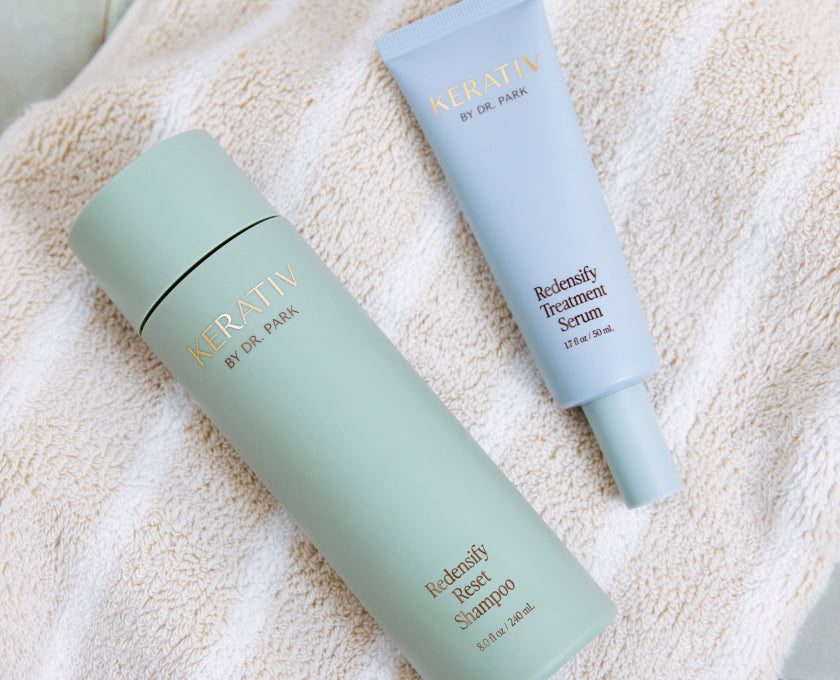
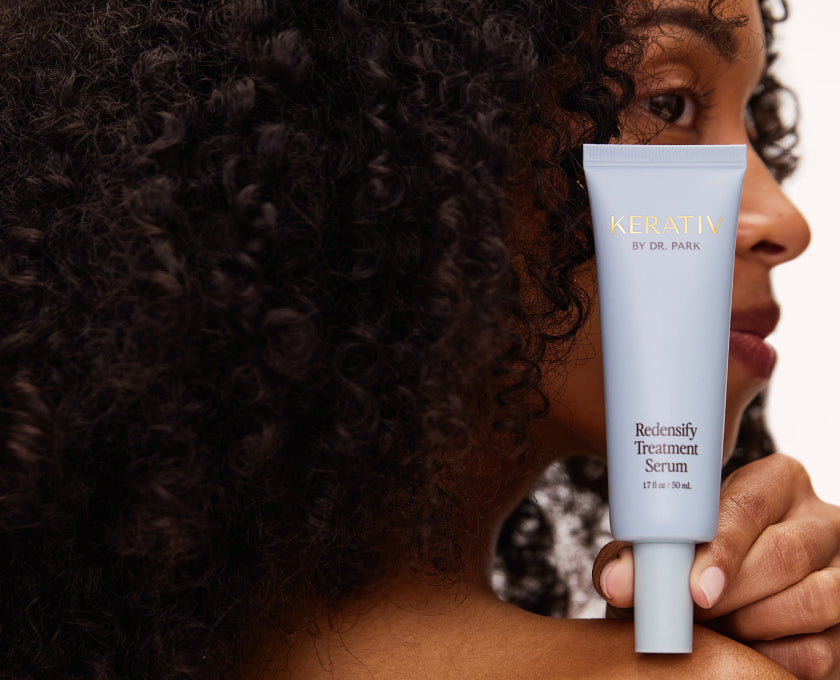
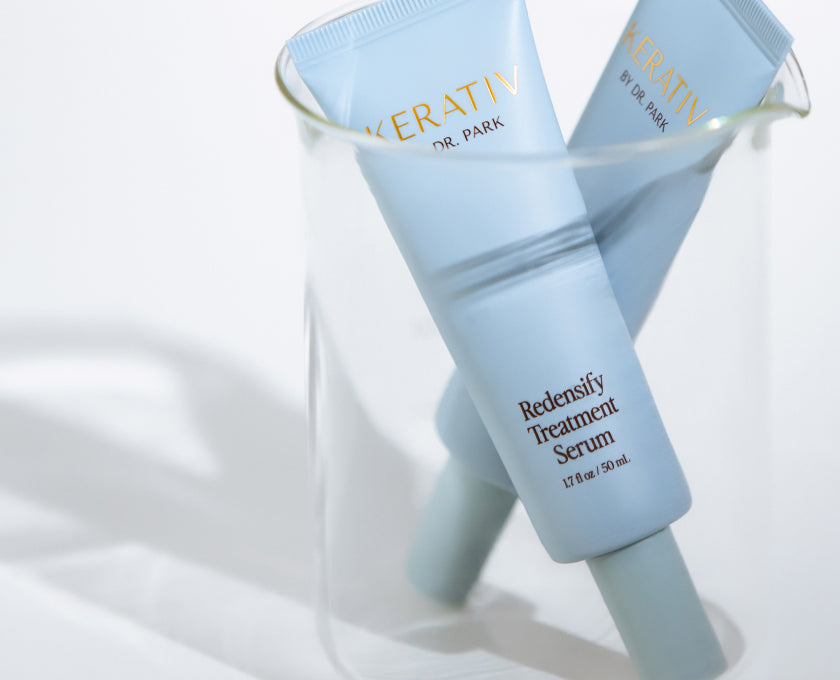
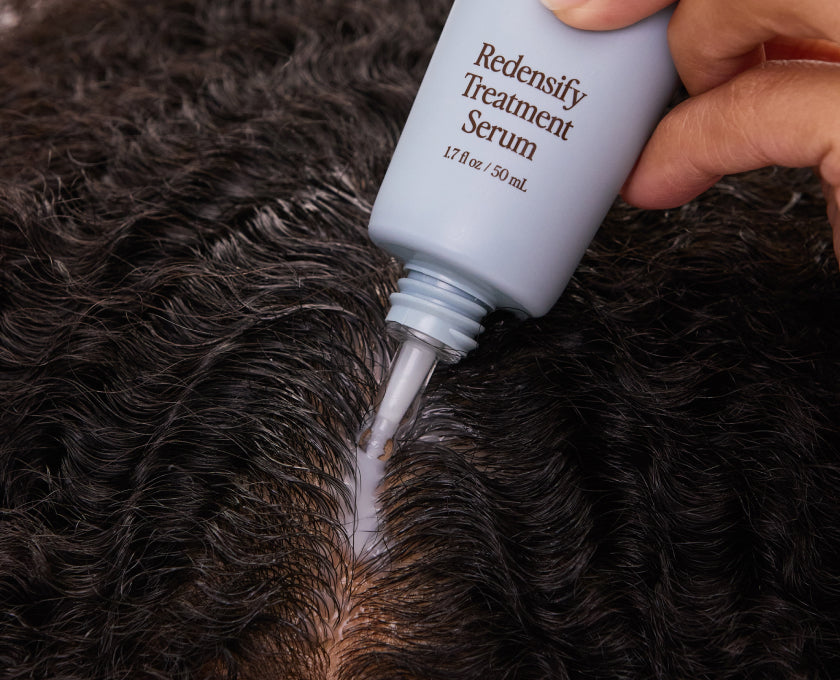
There is one efficiency here worth mentioning. If you are already using a leave-on scalp product, the massage and the application are the same two minutes. I formulated the Redensify Treatment Serum to be sectioned onto the scalp with the needle-nose tip and then massaged in with the fingertips, which means the technique above is simply how you use it. To be clear about what is doing what: the clinical results for the Kerativ Redensify Treatment Serum come from the serum in an independent 24-week study, not from the massage.* The massage is how the product gets where it needs to go, and it is a good habit on its own terms.
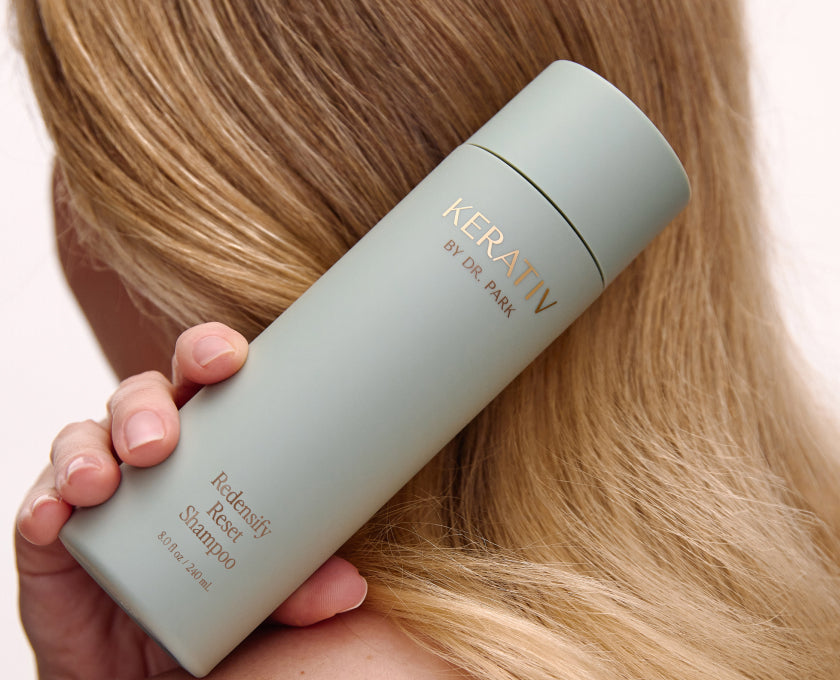
The same applies in the shower. The Redensify Reset Shampoo is meant to sit on the scalp for a few minutes before you rinse, which is a natural place to work the same small circles in. And if you find a formula that is not mine and it makes you consistent, that is the more important half of the equation. Consistency is the part that matters!
Cosmetic products are not drugs and are not intended to diagnose, treat, cure, or prevent any disease. If your hair is shedding heavily or your part is widening, see a board-certified dermatologist to find the cause.
*Based on a 24-week clinical study with 32 participants, dermatologist-evaluated. Results may vary.
Frequently Asked Questions
How long should you massage your scalp each day?
Somewhere between 3 and 5 minutes is a reasonable target, and I would rather you did 4 minutes every day than 20 minutes twice a week, because both studies that exist tested daily protocols and the survey found that months of adherence tracked better with self-reported improvement than any single session length did. If you are already applying a leave-on scalp product twice daily, folding the massage into that application is the easiest way to make it stick without adding anything to your routine.
Is a scalp massager brush better than using your fingers?
I leave this up to your personal preference; some scalp massagers have additional benefits like LED light or heat but using your fingers is just fine too. No matter which you choose, consistency is key.
Can scalp massage make hair loss worse?
Done gently, no. Done aggressively, it can absolutely cause breakage! Tugging at the roots, dragging fingers through dry tangled hair, or leaning on a hard-bristled tool creates mechanical damage that shows up as short broken hairs rather than as hairs shed from the root, and if you are already shedding, that is genuinely the last thing you want. If your scalp is sore afterwards, you have gone too hard.
Should you massage your scalp before or after washing?
Either works and I slightly prefer before, on a dry scalp, because dry hair is less fragile than wet hair and you have more control over what your fingers are doing. That said, the few minutes your shampoo is sitting on the scalp is a natural and easy time to do it, so if that is the version you will actually keep up, do it there and use enough product that your fingers glide rather than pull.
How long before I see a difference from a scalp serum?
You will typically start seeing fuller-looking hair around the 3-month mark with consistent twice-daily use. In the first few weeks your scalp begins to rebalance, and some people notice a brief increase in shedding as follicles shift into a healthier cycle, which is normal and temporary. Around 3 months hair starts to look fuller and denser with less noticeable thinning, and thickness takes longer, which is why I recommend committing to at least 6 months rather than judging it at 6 weeks.
What to Read Next
If you want the biology underneath all this, what scalp health actually does for hair growth explains why the skin your follicles sit in matters at all. For the full routine that massage fits into, my step by step routine for thinning hair turns it into five steps. And if you are weighing scalp massage against things with more evidence behind them, how I rank the alternatives to minoxidil is the honest comparison.
Read more
Most people shed more hair in the fall, because of a shift their follicles quietly made back in midsummer. Dr. Park explains the timeline, and how to tell a normal seasonal shed from something that...
Told your bloodwork was normal but still shedding? Ferritin measures your stored iron, and it falls long before a standard anemia panel goes abnormal. Dr. Park explains what number to ask for, and ...